

Patio Installation in Houston, TX
Saul's Home Improvement designs and builds patios that hold up to Houston's heat, heavy rain, and clay soil. Pavers, poured concrete, flagstone, travertine, and brick, all set on a compacted base the right way so your outdoor room stays flat for decades.


Houston families have trusted our patio builds since 2015
A patio is where your kids learn to ride a bike, where Sunday brisket gets carved, and where you finally catch a breeze at the end of a 95-degree day. We know what that space means, so we build it to last. Every Saul's patio is engineered around Houston's expansive clay, plotted around hurricane-season drainage, and laid tight enough to keep weeds and ants out of the joints for good.
Most patio failures in this region come from two mistakes: pouring over a soft or uncompacted subgrade, and skipping the drainage plan. Our crew brings a plate compactor and a laser level to every build. Each layer gets rolled in 2-inch lifts until the base hits 95 percent Proctor density, then we pitch the surface at a true 1.5 to 2 percent away from your foundation.
- Five patio material options with real samples delivered to your door
- Engineered base with geotextile fabric separating clay from the aggregate
- Houston HOA submissions and Harris County permit paperwork handled for you
Here are the patio materials we install
Every surface has tradeoffs in price, maintenance, and summer heat performance. Here are the five we build most often for Houston backyards.
- 01
Concrete Pavers
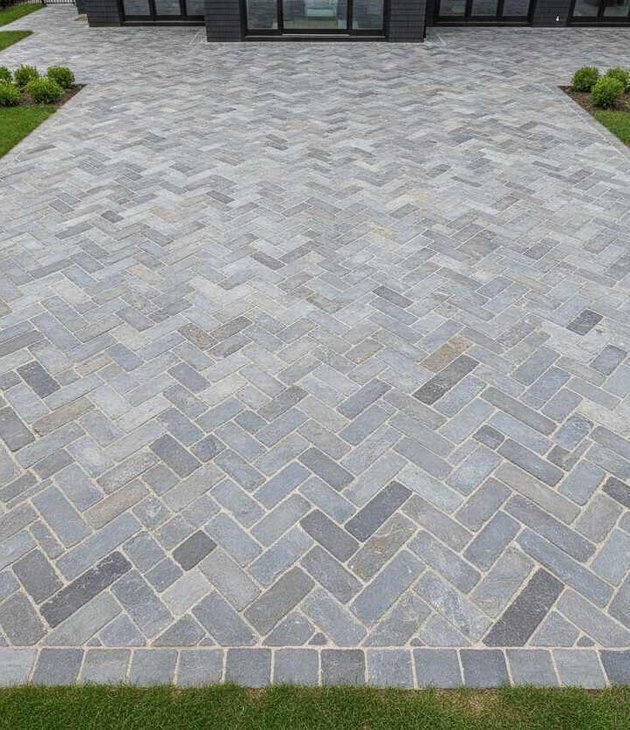
Belgard and Pavestone units in 60+ color blends. Modular, repairable, and the most popular finish in Katy and Sugar Land. Stands up to moisture and shade without algae stains when sealed.
- 02
Poured Concrete
3000 psi mix with fiber mesh, saw-cut control joints, and a broom or salt finish. The budget-friendly choice that covers large footprints fast and stays cool underfoot when stained a lighter tone.
- 03
Oklahoma Flagstone
Irregular sandstone slabs in browns, buffs, and pinks. Dry-laid on aggregate or mortared to a concrete slab. The upscale option for Memorial, Bellaire, and River Oaks properties.
- 04
Travertine
Turkish limestone in tumbled or honed finish. Reflects heat so it reads 15 to 20 degrees cooler than concrete in August, which is why it lines so many pool decks in Clear Lake and The Woodlands.
- 05
Clay Brick
Classic herringbone or running bond patterns for Heights bungalows and older Montrose homes. Natural red or antique reclaimed brick in a mortared or polymeric-sand joint.
How should you size a patio for a Houston home?
Morning Coffee Patio (120 to 200 sq ft)
Enough room for a small bistro set and a grill. A good fit for narrow zero-lot-line yards in East End and Midtown. Starts around $4,500.
Family Dinner Patio (250 to 400 sq ft)
Fits a six-seat table plus a sofa. The sweet spot for most Cypress and Pearland lots. Budget $8,500 to $14,000 depending on material.
Entertainer Patio (500 to 800 sq ft)
Space for a dining zone plus a lounge zone plus a pergola or outdoor kitchen. Typical for larger Memorial and Kingwood estates at $18,000 to $30,000.
Full Outdoor Room (900+ sq ft)
Covered structure, full kitchen, fireplace, and lounge area. Plan for $35,000 to $75,000 and a 6 to 10 week build window.
Why Houston Picks Saul's for Patios
20+ Years On Gulf Coast Soil
Our base specs are written for Vertisol clay, not generic Sunbelt conditions.
Licensed, Bonded, $2M Insured
Every patio quote includes a copy of our current COI for your records.
Same-Crew, Same-Foreman Model
No subcontractor churn. The installer who pours the footer is the one who seals the patio.
Here is how our patio build process works
From the first measure to the final seal coat, every patio follows the same four-stage sequence.
- 01
Measure & Sketch
We come out with a laser level, mark the footprint in paint, and deliver a scaled drawing with your top two material picks within five business days.
- 02
Excavation & Base
We dig out 8 to 10 inches, roll out woven geotextile, and build a 6-inch road base in two compacted lifts with mechanical tampers.
- 03
Surface Install
Whether we are setting pavers on 1-inch bedding sand or pouring a 4-inch reinforced slab, the finish work goes in the same day the surface is set.
- 04
Seal & Hand-Off
Polymeric sand joints, joint activation, pressure wash, and a written care guide. We haul off every scrap of debris before we leave.
We build patios across the Greater Houston metro
Crews dispatched daily from Harris, Fort Bend, and Montgomery counties.
Questions homeowners ask about patios
How long does a patio install take?
A 250 sq ft paver patio usually takes 4 to 7 working days from excavation to polymeric sand. Poured concrete adds 24 to 48 hours for the initial cure. Rain delays during hurricane season can push that by a day or two, which is why we hold a weather buffer in every contract.
Do I need a permit for a backyard patio in Houston?
The City of Houston usually does not require a permit for a ground-level, uncovered patio, though some unincorporated Harris County tracts and MUDs do. Covered patios, patios over 30 inches tall, and anything tied into structural posts almost always need a permit. We pull every required permit as part of our scope.
Pavers or concrete for a Houston backyard?
Pavers win on long-term durability in clay soil because each piece moves independently instead of cracking. Concrete wins on upfront cost and modern looks when you want a monolithic slab with saw-cut joints. If resale is the main driver, pavers tend to recover more of their cost at closing.
Will my patio get hot in August?
Darker pavers and stained concrete can clear 140 degrees in direct sun. Lighter travertine, ivory tumbled pavers, and buff flagstone stay closer to 115 degrees. Shade from a pergola, patio cover, or shade sail drops surface temps another 20 to 30 degrees.
Can you tie a new patio into my existing slab?
Yes, patio extensions are some of our most common projects. We drill and epoxy rebar dowels into the existing slab, match the surface elevation within an eighth of an inch, and pour a new section. Paver overlays over sound concrete are another popular budget-friendly path.
How do you deal with yards that drain toward the house?
This is common in older Galleria and Bellaire neighborhoods. We install a channel drain along the patio edge closest to the slab, tie it into a 4-inch SDR-35 line, and pitch the surface to the drain. That redirects runoff from tropical storms before it can reach the foundation.
What maintenance does a patio need?
Plan on a pressure wash and polymeric sand top-off every three to four years for pavers. Stamped concrete needs a re-seal every two to three years to stay vibrant. Flagstone and travertine rinse clean with a leaf blower and an annual mild detergent scrub.


