

Paver Installation in Houston, TX
Driveways, patios, pool decks, and walkways laid tile-by-tile with the ICPI-spec base every paver needs to survive Houston heat and hurricane rain. Saul's Home Improvement has set over 1.2 million square feet of pavers since 2015.


Other contractors call our Houston paver installers for help
Concrete pavers are the most forgiving hard surface you can put down in Houston. They flex with clay-soil movement, drain through open joints, and can be pulled up and reset when a tree root or utility trench goes through. The catch is they only perform that way if the base is built right.
We run crews trained to Interlocking Concrete Pavement Institute (ICPI) standards. That means 6 to 8 inches of crushed limestone road base compacted in 2-inch lifts, a true 1-inch bedding sand layer screeded to grade, and polymeric sand joints activated with a slow-fill water pass. Every paver project carries our 5-year workmanship warranty against settlement, heaving, and joint blowout.
- Direct dealer pricing with Belgard, Pavestone, and Oldcastle lines
- Permeable paver systems for water-restricted HOAs
- Free on-site mockup with three paver color samples before you sign
Here are paver styles and color families
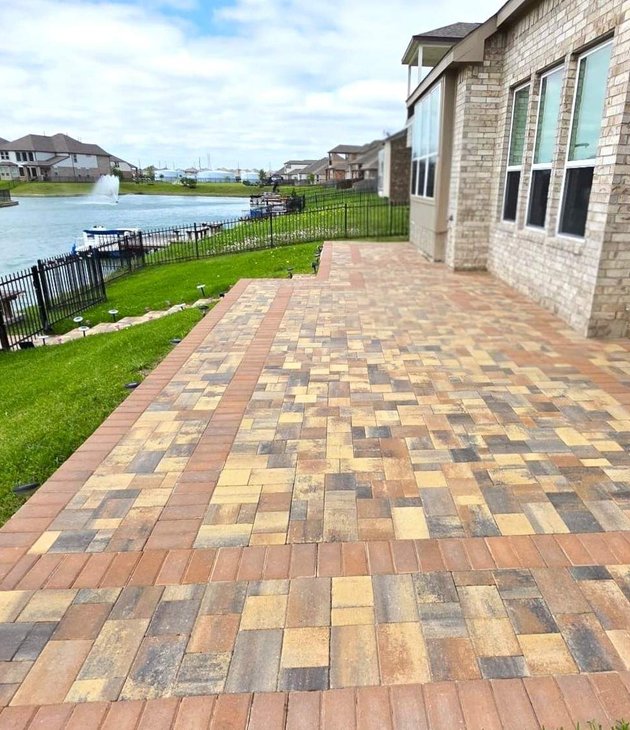
Your paver choice sets the architectural tone of the whole yard. Here are the categories we pour most for Houston homes.
- 01
Modern Plank
Belgard Dimensions and Pavestone Plaza Plank. Long, low-profile units in greys and charcoals that pair well with modern farmhouse and contemporary elevations.
- 02
Classic Holland
Rectangular 4x8 units in herringbone or running bond. The workhorse of Houston driveways because the interlock pattern spreads vehicle loads across neighbors.
- 03
Old World Cobble
Belgard Cambridge or Mega-Arbel tumbled pavers in buff, sand, or toasted walnut blends. The right choice for French Country and Tuscan-leaning homes in River Oaks and Memorial.
- 04
Large Format Slab
24-inch porcelain and 16x24 concrete slab pavers for luxury pool decks. Minimalist grout lines and lighter colors keep surface temps manageable.
- 05
Permeable
Open-joint pavers with 3/8-inch spacing and a #8 stone base. Lets rainwater infiltrate to relieve stormwater load, which qualifies for credits in some HOAs and MUDs.
Here is how our ICPI-spec base construction process works
Step 1 — Excavation
We dig to a total depth of 8 inches for patios and 12 inches for driveways. Soil gets hauled off, not sidecast, so your yard does not end up two inches higher than we started.
Step 2 — Geotextile
We roll out Mirafi 140N non-woven geotextile across the entire subgrade. This keeps Houston clay from pumping up through the aggregate, which is the single biggest cause of paver failure in our market.
Step 3 — Road Base
Crushed limestone, placed in two 3-inch lifts and compacted with a 3,500-pound reversible plate compactor. We target 95 percent Proctor density, verified with a penetrometer in random spots.
Step 4 — Bedding Sand
ASTM C33 concrete sand, screeded 1 inch thick with rail guides. This is the only layer pavers touch. Anything thicker is a shortcut that leads to rutting.
Step 5 — Set, Cut, Seal
Pavers laid by hand in pattern, cut with a wet saw at edges, locked in with concrete edge restraints, and finished with polymeric sand swept into the joints.
Why Our Paver Jobs Last
Calibrated Compaction
We measure density. Most competitors guess.
Concrete Edge Restraints
Plastic edges flex and fail. We pour a concrete toe at every perimeter.
Polymeric Joint Sand
Techniseal NextGel or Alliance Gator Maxx to lock joints and block weeds for a decade.
Here is what your paver project timeline looks like
From the first phone call to the final joint pass, here is how a typical paver job moves.
- 01
Week 1 — Site Visit
We map grade, mark utilities, and pull paver samples from the truck for you to hold against the house.
- 02
Week 2 — Design Lock
CAD drawing, pattern map, color blend, and permit packet ready for signature.
- 03
Weeks 3-4 — Build
Excavation Monday, base Tuesday-Wednesday, pavers Thursday, cuts and edges Friday for a typical 400 sq ft patio.
- 04
Close-Out
Polymeric sand, final compaction, pressure rinse, and a walk-through before final payment.
We install pavers across the Greater Houston metro
Crews dispatched daily from Harris, Fort Bend, and Montgomery counties.
Questions homeowners ask about paver installation
Will pavers sink in Houston's clay soil?
Not when the base is built to ICPI spec. Our 6-inch crushed limestone base with a geotextile separator gives the pavers a stable platform that is completely decoupled from the clay subgrade below. We have seen our paver jobs stay perfectly flat through the Memorial Day flood, Harvey, and every freeze since.
How long do concrete pavers last?
Manufacturers rate them for 25 to 50 years. In Houston, a properly installed paver surface typically outlives the house it was built for. The occasional settled unit can be pulled, the base leveled, and the paver re-seated in under an hour. Try that with a cracked concrete slab.
Can you install pavers over existing concrete?
Yes, paver overlays are a great way to save a slab that is still structurally sound. We mortar-set thin Belgard Permafix pavers directly over the concrete, add a drainage mat if needed, and finish with polymeric sand. Overlays typically save 30 to 40 percent versus a full tear-out.
Do pavers work for a driveway?
Paver driveways are engineered to carry 10,000-pound axle loads when built with a 12-inch base and 80 mm thick (3 1/8 inch) units. We have installed hundreds from Sugar Land to The Woodlands without a single crack or rut. They cost more than concrete but add more resale value.
What is polymeric sand and why does it matter?
It is silica sand mixed with polymer binders that harden when wet. Swept into paver joints and activated with a slow water pass, it locks pavers together, blocks weed seeds, and keeps ants out. We use Techniseal NextGel or Alliance Gator Maxx, both proven in Gulf Coast humidity.
How do pavers handle hurricane-season flooding?
Better than any other hard surface. Water drains through the joints or off the sloped surface to a discharge point. Even if a paver pad goes underwater, the interlocking units and compacted base stay in place while the water drains. Permeable pavers handle a 3-inch hourly downpour without standing water.
Do I have to seal my pavers?
It is optional. Sealing enhances color and makes the surface easier to clean, but unsealed pavers perform just as well. If you seal, use a breathable water-based sealer every 3 to 5 years. Avoid solvent-based products in Houston humidity because they can trap moisture and turn hazy.


